Savings accounts: daily interest, paid monthly
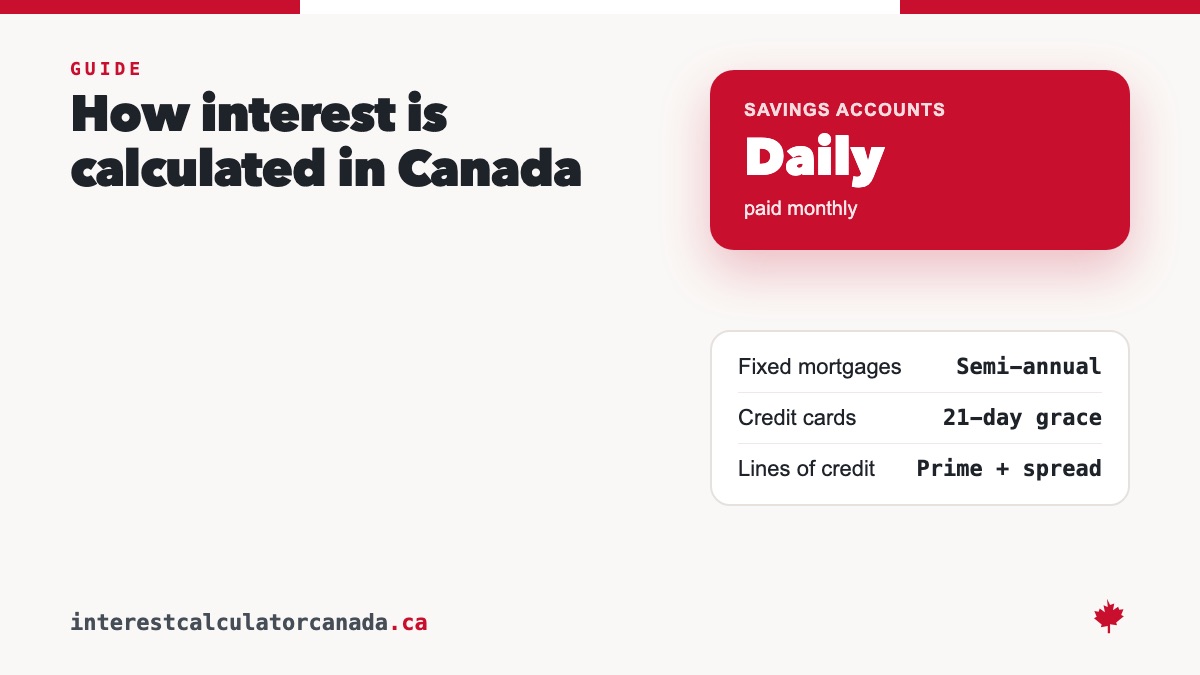
Most Canadian banks calculate interest every day on your closing balance using the annual rate ÷ 365, then pay the total into your account once a month. Because paid interest earns interest the next month, the effect is monthly compounding. Model it with the savings interest calculator.
GICs: annual compounding or regular payouts
Multi-year GICs usually compound annually and pay everything at maturity. Others pay interest out annually, semi-annually or monthly, which is simple interest because the payments do not compound inside the GIC. Compare terms with the GIC ladder calculator.
Mortgages: semi-annual compounding
The Interest Act requires blended-payment mortgages to state their rate calculated yearly or half-yearly, not in advance. Fixed-rate mortgages are therefore compounded semi-annually and the rate is converted to an equivalent rate per payment. Details and examples: mortgage interest calculator.
Lines of credit: daily interest at prime plus a spread
Interest is the daily balance × (prime + spread) ÷ 365, added up and charged monthly. When prime changes, your rate changes the same day. See the line of credit calculator.
Credit cards: a 21-day grace period, then daily interest
Federally regulated issuers must give at least 21 interest-free days on new purchases when the full balance is paid by the due date. If you carry a balance, interest is charged from the transaction date at the card’s annual rate ÷ 365 per day. Cash advances usually accrue interest immediately. See the credit card calculator.
Comparing rates fairly
Because compounding differs, convert rates to an effective annual rate before comparing — the interest rate converter does it instantly.
| Product | How interest is calculated | Compounding |
|---|---|---|
| Savings account | Daily on closing balance | Paid monthly (≈ monthly) |
| GIC | On the amount invested | Usually annual, or paid out |
| Fixed mortgage | Per payment period | Semi-annual |
| Line of credit | Daily at prime + spread | Charged monthly |
| Credit card | Daily after the grace period | Charged monthly |
Frequently asked questions
Do Canadian banks calculate interest daily?
For most savings accounts, lines of credit and credit cards, yes. Mortgages are calculated per payment period using a semi-annually compounded rate.
Why is my mortgage rate compounded semi-annually?
Because the Interest Act requires mortgage rates to be stated as calculated yearly or half-yearly, not in advance, and lenders use half-yearly compounding.
How do I compare a savings rate with a GIC rate?
Convert both to effective annual rates using the interest rate converter, then compare.
Results are estimates based on the figures you enter and assume rates do not change. They are not financial advice.