The short answer
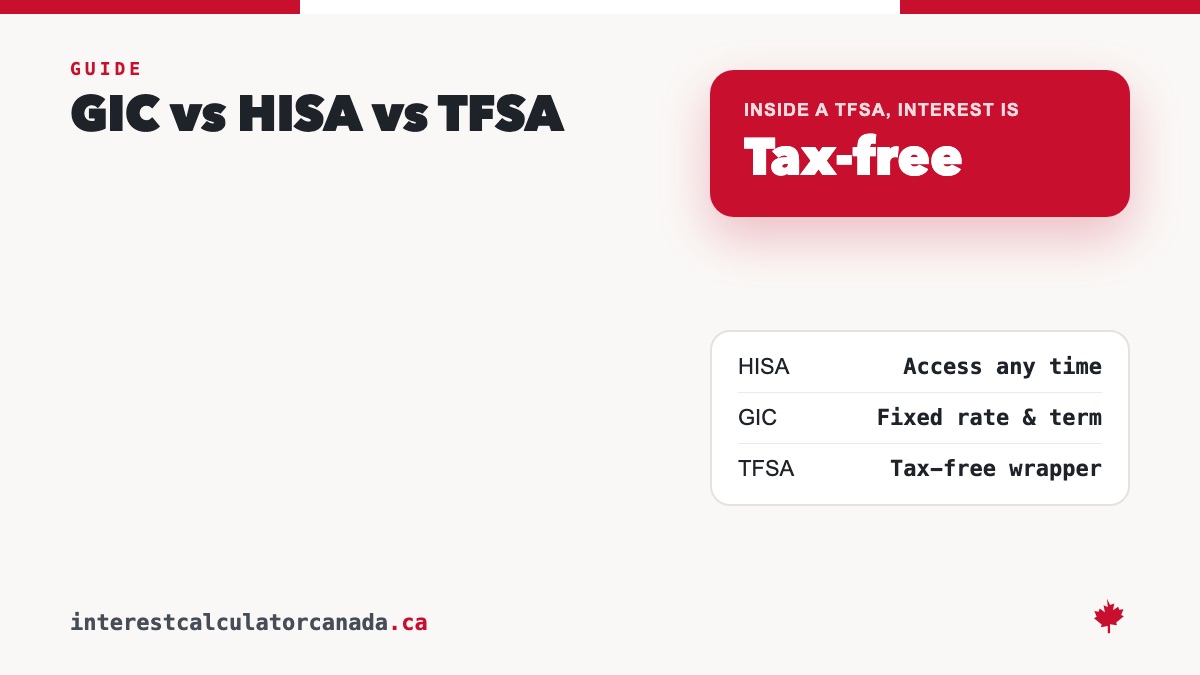
- High-interest savings account (HISA): money you might need at any time, such as an emergency fund.
- GIC: money you will not need for a fixed period, in exchange for a guaranteed and often higher rate.
- TFSA: a tax-free wrapper you can put either of them in — and use first, before a taxable account.
Side by side
| HISA | GIC | TFSA | |
|---|---|---|---|
| What it is | Savings account | Fixed-term deposit | Registered account type |
| Access to money | Any time | At maturity (unless redeemable) | Any time; depends on what it holds |
| Rate | Variable | Fixed for the term | Whatever the investment earns |
| Deposit insurance | Yes, at CDIC members | Yes, eligible GICs | Separate CDIC category for eligible deposits |
| Tax on interest | Taxable | Taxable | Tax-free |
Example: $20,000 for 3 years
| Option | Balance after 3 years | Interest |
|---|---|---|
| HISA at 3% (monthly) | $21,881.03 | $1,881.03 |
| GIC at 3.5% (annual) | $22,174.36 | $2,174.36 |
| Same GIC, taxable at 30% | $21,506.31 | $1,506.31 |
| Same GIC inside a TFSA | $22,174.36 | $2,174.36 (tax-free) |
Example rates for illustration. Run your own numbers with the savings calculator, the GIC ladder calculator and the TFSA calculator.
A simple plan
- Keep an emergency fund in a HISA — inside your TFSA if you have room.
- Put money for known future expenses (a car, a down payment in two years) in GICs that mature when you need it.
- Use available TFSA room before holding interest-bearing savings in a taxable account.
Frequently asked questions
Can I hold a GIC in a TFSA?
Yes. Banks and credit unions offer TFSA GICs, and the interest is tax-free.
Is a HISA or a GIC better for an emergency fund?
A HISA, because you can withdraw at any time. A non-redeemable GIC locks your money until maturity.
Are TFSA deposits covered by CDIC?
Eligible deposits held in a TFSA at a CDIC member institution are covered as their own category, separate from your non-registered deposits.
Results are estimates based on the figures you enter and assume rates do not change. They are not financial advice.