How to use this interest calculator
- Enter what you have today and the annual interest rate your bank quotes.
- Choose the compounding. Most Canadian high-interest savings accounts calculate interest daily and pay it monthly — “monthly” is a close match. Many GICs compound annually.
- Add regular deposits, such as a monthly transfer from your chequing account, and choose whether they land at the start or the end of each period.
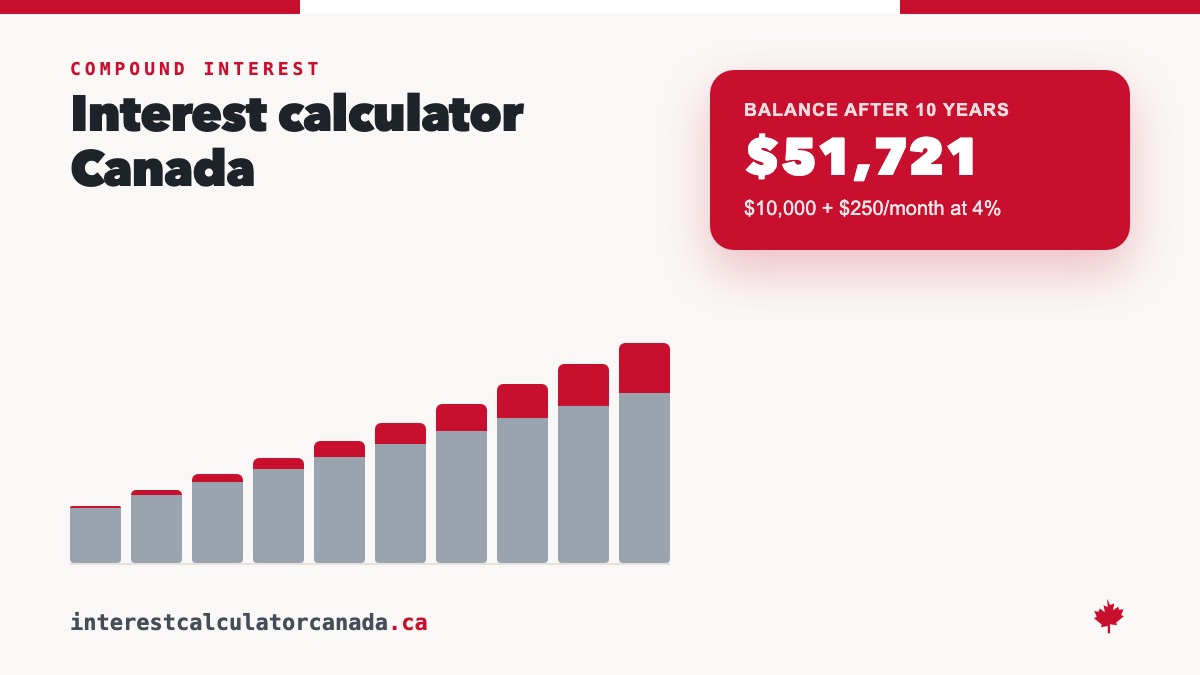
- Read the results. The red box shows your future balance; the chart and table split it into what you put in and what interest added.
The compound interest formula
For a single deposit, the balance after t years is:
where P is the starting amount, r the annual rate as a decimal and n the number of times interest compounds per year. Regular deposits are added period by period, which is exactly what the calculator does — no shortcuts or rounding until the final display.
Examples at 4% compounded monthly for 10 years
| Starting amount | Monthly deposit | Balance after 10 years | Interest earned |
|---|---|---|---|
| $1,000 | — | $1,490.83 | $490.83 |
| $10,000 | — | $14,908.33 | $4,908.33 |
| $10,000 | $250/month | $51,720.78 | $11,720.78 |
| $25,000 | $500/month | $110,895.72 | $25,895.72 |
How much does compounding frequency matter?
$10,000 at a 5% annual rate for 10 years:
| Compounding | Balance | Effective annual rate |
|---|---|---|
| annually | $16,288.95 | 5.000% |
| semi-annually | $16,386.16 | 5.062% |
| quarterly | $16,436.19 | 5.095% |
| monthly | $16,470.09 | 5.116% |
| daily | $16,486.65 | 5.127% |
More frequent compounding helps, but the difference between monthly and daily is small. The rate itself and the time you leave the money invested matter far more. To compare two quotes fairly, convert them to an effective annual rate with the interest rate converter.
More Canadian interest calculators
Frequently asked questions
How is interest calculated on a Canadian savings account?
Most Canadian banks calculate interest daily on the closing balance and pay it into the account monthly. Because paid interest then earns interest, it behaves like monthly compounding.
What is the difference between the interest rate and the effective annual rate?
The quoted rate is a nominal annual rate. The effective annual rate includes the effect of compounding during the year, so 5% compounded monthly is 5.116% effective.
Does this calculator include tax?
No. It shows growth before tax, which is what you get in a TFSA. For a side-by-side comparison with a taxable account, use the TFSA calculator.
Are the results guaranteed?
No. They assume the rate stays the same for the whole period. Variable savings rates change over time, so treat the results as an estimate.
Results are estimates based on the figures you enter and assume rates do not change. They are not financial advice.